By Kristina Colson, AI Strategy Lead
Nearly every headline, vendor pitch, and business strategy conversation is about AI. You’re not imagining it. All business leaders are under pressure to do something with AI.
Yet most organizations are still struggling to gain traction and turn AI initiatives into real business impact. A Boston Consulting Group report from October 2024 found that 74% of companies are struggling to show tangible value from AI and move beyond proofs of concept, and a recent survey by MIT suggests the trend continues in 2025. We see the same challenge first-hand with the companies we work with every day.
The issue isn’t the technology. It’s that most organizations haven’t built the readiness or capabilities to use it effectively.
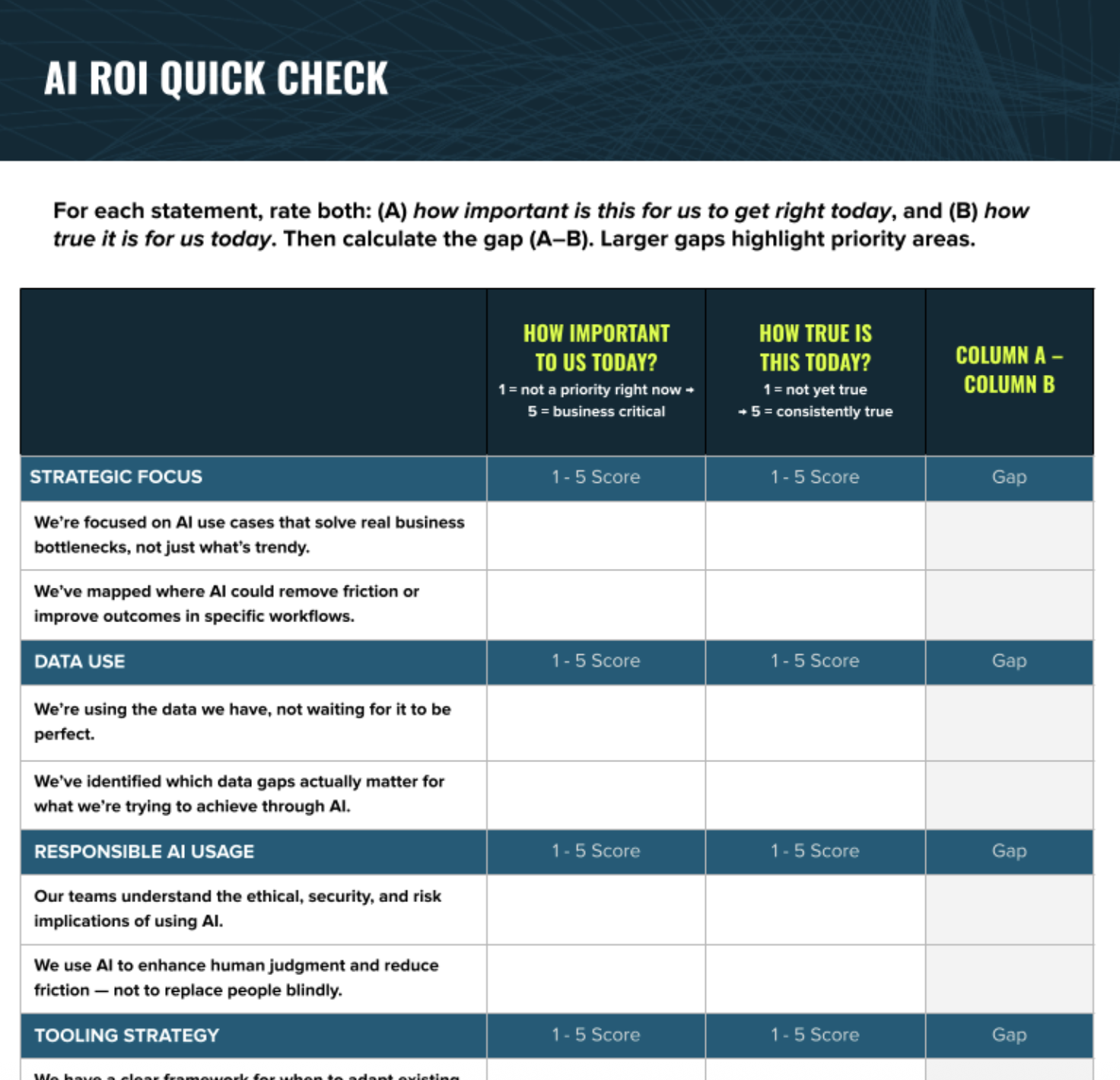
For the past several years, we’ve worked alongside a range of companies within Iowa and beyond as they’ve begun their AI journey. Here are five principles we’ve found most critical to setting organizations up for success with AI.
1. Solve Real Problems, Not Trendy Ones
It’s tempting to chase what others in the industry are doing, but AI isn’t one-size-fits-all. It needs to fit your specific workflows, your data, and your goals. Ask things like: “Where are we bottlenecked?” “What slows our teams down?” or “What insights are we missing that could improve our outcomes?”
The highest impact comes from eliminating operational bottlenecks, something we consistently see in our own work. Target the points where relieving pressure unlocks time and efficiency.
2. Start with the Data You Already Have
You don’t need “perfect data” to begin using AI effectively. While clean, structured data is critical for certain types of AI work, like unsupervised machine learning or forecasting, gen AI tools (like ChatGPT or Claude) excel at handling imperfect and incomplete inputs – think emails, transcripts or service notes.
By starting quickly rather than worrying about clean data, you’ll learn which gaps really matter and where targeted data cleanup is worth further investment and time.
3. Balance Responsibility with Efficiency
AI works best when it enhances human potential, not when it blindly replaces it. It can process data quickly, reduce cognitive load, and eliminate repetitive tasks, but it doesn’t understand your customer relationships, your team dynamics, or the ethical implications of its output.
Ensure you balance responsibility with efficiency by asking critical questions like: “What are the consequences of exposing this data to AI?” “Are we making life easier for teams, or quietly burdening them with more uncertainty?” or “What are the potential risks to our business or others?”
The best use of AI enhances your team, keeps humans in the loop, and maintains transparency with customers and partners.
4. Use Proven Tools Before Building Custom
Most organizations don’t need to train their own model to see real impact within their business.
Organizations like OpenAI, Anthropic, Google and others are investing heavily in making their LLMs better every day and you can build on that progress directly.
Many problems are already solved and existing AI tools can often be adapted quickly. Take language: your organization might use jargon or acronyms that generic AI won’t understand. Instead of building custom models, use approaches like Retrieval-Augmented Generation (RAG) to inject business context efficiently.
5. Don’t Go It Alone
Like any tool, AI has a learning curve. While many businesses can make progress on their own, it often takes longer and involves more trial and error.
Whether you’re a smaller company without deep technical resources or a large enterprise with complex systems, the lesson is the same: don’t try to learn everything the hard way. Collaborating with partners, peers, or industry groups helps you learn faster, avoid common missteps, and see value sooner.
The Bottom Line
AI can absolutely move the needle for businesses. By focusing on real problems, starting with the data you have, balancing responsibility with efficiency, using proven tools, and learning alongside others, you’ll be far more likely to turn AI pilots into real business value.
This article was originally published in the September 2025 Corridor Business Journal – AI Edition.

.svg)
.svg)
.svg)
.svg)

.svg)
.svg)
.svg)